
Arbor Day: Symbiosis Instead of Competition
Tomorrow, April 25th, we celebrate Arbor Day. According to the German Association for the Protection of Forests (Schutzgemeinschaft Deutscher Wald, SDW), it was introduced in Germany as early as 1952 – since then, it has served as the largest hands-on initiative and a reminder of how vital trees are for both humanity and the environmen.
And let’s be clear: Trees are magnificent. specially in urban settings, they provide shade, store CO₂, and offer vital habitats. At the same time, it is becoming increasingly evident that in highly densified city centers, there is a harsh reality between the ambition of “planting more trees” and ensuring those trees remain healthy and effective in the long term.
Trees in the City Center
In our blog article “(Healthy) Greenery in the City?”, we describe this issue more specifically: “Planting trees in inner-city areas is becoming increasingly challenging. The ground is often sealed, crisscrossed with cables, or tunneled, making it unsuitable as a location for trees.”
Furthermore, a tree requires time, care and, above all, the right conditions. Many ecosystem services only develop as the tree ages – and young trees must be particularly well-supported through dry periods during their initial years.
Munich as an Example: Heat Islands, Irrigation Needs – and High Costs
The current debates surrounding Munich’s city centerdemonstrate how complex urban greenery is, both for existing stock and new plantings. A city council briefing clearly identifies the burden of heat islands: “Especially in highly densified city centers, we are already seeing so-called heat-island effects and heat hotspots.” To combat this, Munich has ambitious plans: up to 150 new trees are to be plantedin the densely populated old town to make the city more climate-resilient.
However, the figures are striking. According to the Building Department, “the approximately 75,000 euros received can only finance a single tree”, as reported by the Süddeutsche Zeitung.
Also Kommune21 cites figures that stand out in public discussion:
“The Building Department (Horticulture) estimates costs of up to nearly 100,000 euros per tree.”
These sums are not driven by the sapling itself but by the complex environment. Tunneled, sealed, and filled with utility lines – the urban subsurface is often a logistical bottleneck that makes tree planting extremely difficult.

Photo: Andre Magalhae from Unsplash
Smart City Meets Urban Greenery
Given these investments, ensuring successful establishment has become a priority. Conventional “one-size-fits-all” watering routes are increasingly giving way to data-driven approaches. Under the term „Urban Tree Intelligence“, sensors are used to measure actual water requirements.
So, how can urban greenery be irrigated efficiently in hot summers without wasting water? Kommune21 describes the approach as follows: “Instead of watering everything across the board, the trees report their water needs via radio, allowing the city to run targeted irrigation routes.”
The logic is clear: during dry periods, better data and better decision-making are essential – especially when personnel, budgets, and water resources are limited. Smart solutions incorporate weather data and so-called “tree personalities” to generate forecasts even for trees without their own sensors. Nevertheless, the challenge remains in areas with extreme soil sealing: for healthy growth, a tree needs roughly as much space underground as its crown will eventually occupy above.
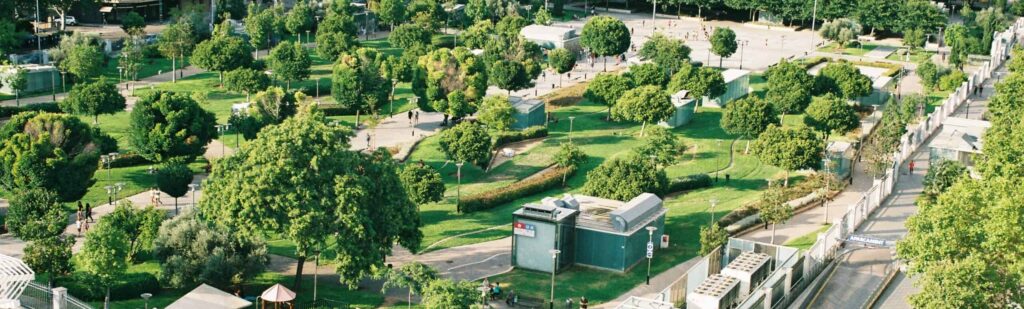
Photo: Nerea Marti Sesarino
Nature-Based Solutions as a Necessary Supplement
At Green City Solutions, our stance is clear: urban trees and moss filters belong together – a symbiosis for different conditions.
There are many locations where trees face extreme difficulties (subsurface, space, utility lines, sealing) – yet these are precisely the areas where a large number of people would benefit from cooling and air purification: busy streets, squares, schoolyards and transit stops.
This is exactly where our fresh air concepts come into play – local, measurable and immediately effective. They combine the natural cleaning and cooling power of moss with state-of-the-art IoT technology. They combine the natural cleaning and cooling power of moss with state-of-the-art IoT technology. In a very small footprint, an electrical input of approx. 50 watts can generate up to 6,500 watts of cooling power – equivalent to the performance of 80-100 newly planted street trees. Furthermore, the filtering effect for airborne particles is about 10 times higher than that of traditional greenery.
The goal is not to “clean the air of an entire city,” but to create fresh air zones where heat and fine dust pollution are high and many people congregate. Because we are certain: “Moss must move into the city.”
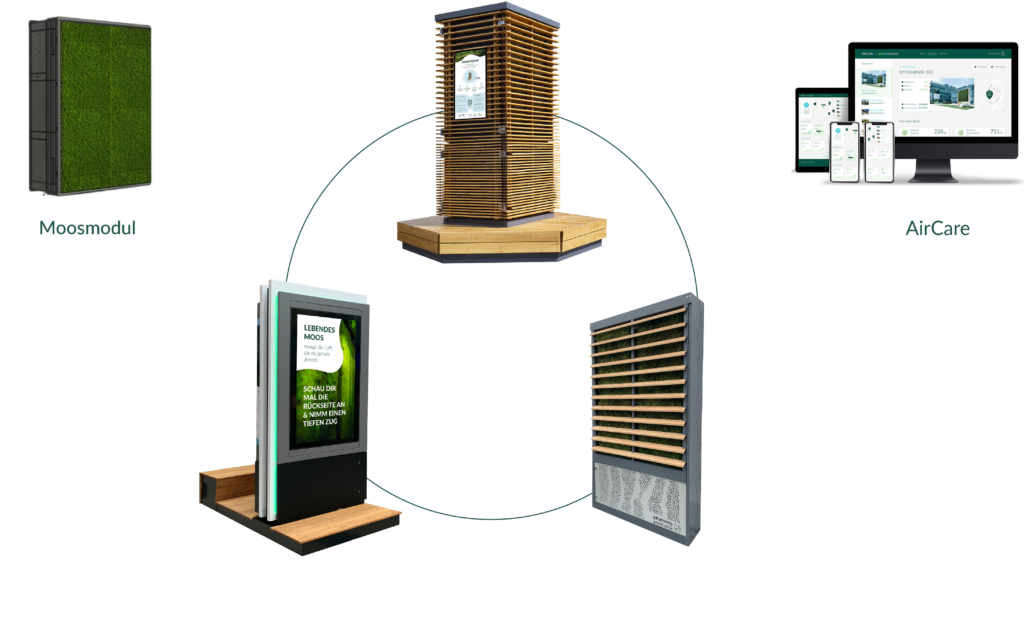
Photo: GCS
Arbor Day: Symbiosis Instead of Competition – Moss and Trees Working Together for a Colder City
Arbor Day rightly reminds us of the value of long-term, living infrastructure. However, the “trees vs. technology” debate falls short in modern urban planning. It is about a functioning ecosystem. While trees act as long-term measures, moss filters provide immediate filtration and can even relieve existing greenery through evaporative cooling.
Practice in city centers shows that we need an “and”: a combination of smart tree planting, quality care – and additional nature-based solutions that can unfold their impact immediately on a small footprint.
For more information on soil sealing, impact, costs and symbiosis, read: “(Healthy) Greenery in the City?”


Photos: GCS & Olena Bohovyk from Unsplash