
„Europe is hunting a killer called particulate matter“, was the headline in German weekly DER SPIEGEL at the end of November. The trigger „new data from the European Environment Agency (EEA)“, that, as as Deutsche Umwelthilfe (DUH) points out, once again demonstrate „the serious health impacts of poor air quality in Germany“ and across Europe.
Air pollution is deadly – why Europe’s progress is still not enough
With its latest analysis, „Harm to human health from air pollution in Europe: burden of disease status, 2025“, the EEA once again delivers clear evidence: despite significant progress, 95% of urban residents in Europe are still exposed to air pollution levels above WHO recommendations. Fine particulate matter (PM₂.₅), nitrogen dioxide (NO₂) and ground-level ozone (O₃) drive cardiovascular disease, strokes, diabetes, asthma and lung cancer – and lead to hundreds of thousands of premature deaths.
For Germany, Deutsche Umwelthilfe has analysed the EEA data:
In 2023 alone, according to DUH, 57,564 deaths were attributable to particulate matter, 23,013 to nitrogen dioxide and 22,114 to ozone . At the same time, SPIEGEL reports a decline in the overall number of victims – a success of stricter limit values and air quality measures. However, the scale remains dramatic: Air pollution continues to be one of the major health risks of our time.
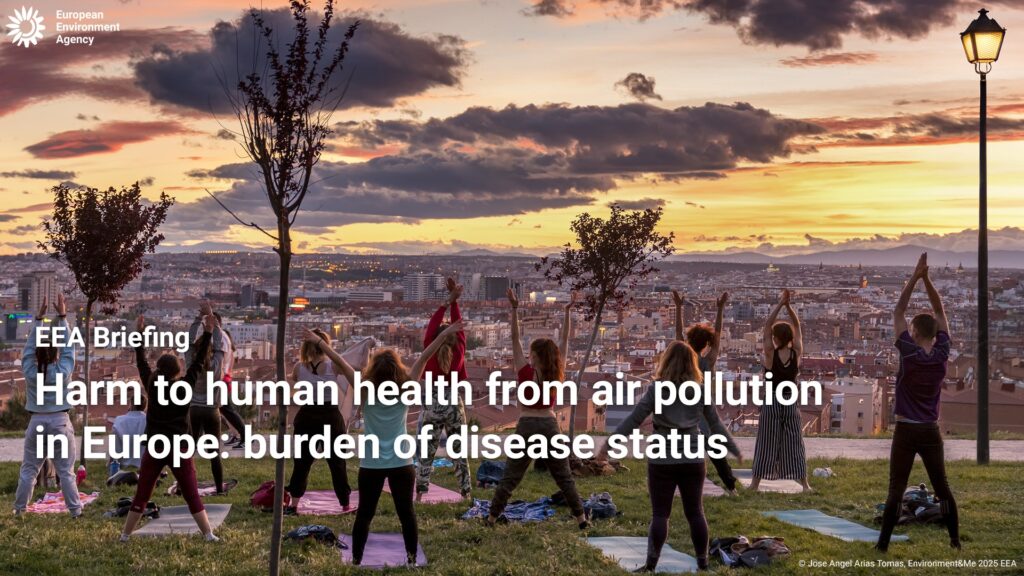
Photo: EEA on Facebook
Clean air is preventive healthcare
The EEA clearly shows how closely air quality and disease burden are linked: Particularly affected are ischaemic heart disease, strokes, COPD, diabetes and, increasingly, dementia.
Nature-based solutions for urban spaces
Many of these health burdens arise exactly where people live their everyday lives: where they live, work, shop and wait – on streets, squares, at public transport stops and in dense urban districts.
This is precisely where Green City Solutions’ Fresh Air Concept comes in. The goal: To provide cleaner, cooler air right where people need it most.
Avoiding emissions remains the most important lever – without a transformation in transport and energy and strict exhaust standards, there will be no healthy air. At the same time, practical experience in many cities shows that even ambitious policies will not prevent exceedances of limit and guideline values at urban hotspots for years to come.

Photo: Markus Spiske
Clean air is preventive healthcare
The EEA clearly shows how closely air quality and disease burden are linked: Particularly affected are ischaemic heart disease, strokes, COPD, diabetes and, increasingly, dementia.
This is where nature-based, plant-based solutions come in:
- Green City Solutions’ regenerative bio-filter combine the natural filtering power of moss with intelligent sensors and efficient ventilation.
- On just 9 m², for example, a CityTree can deliver the effect of up to 81 trees – with up to 82% fine dust reduction, up to 5,000 m³ of waste-free filtered air per hour and a measurable cooling capacity of up to 6,500 W/h.
- In Green City Solutions’ bio-digital innovations, this air filtration and cooling is integrated with enhanced user experience: green climate islands that provide shade and cooling while also offering space for information and digital communication.
These moss-based filters are not a substitute for emission reduction. They are the missing piece directly in the urban fabric. They improve urban air quality where conventional measures reach their limits: in narrow street canyons, heavily used squares or traffic-dominated junctions.
From report to implementation
The latest figures make one thing perfectly clear: every microgram less of PM and NO₂ translates into additional years of healthy life – immediately. At the same time, the revised EU Ambient Air Quality Directive requires cities and member states to meet significantly stricter limit values by 2030.
Instead of waiting for the next report, municipalities, developers, transport operators and retail locations can act now:
- Transform urban districts and squares into genuine fresh-air islands
- Upgrade stops, shopping streets and passages with moss-based filters to improve both air quality and user experience
- Future-proof real estate portfolios and deliver visible, measurable contributions to ESG and health targets
Future-ready, green urban spaces
Wherever responsibility for urban development, real estate, mobility or public health is assumed, now is the right time to develop a fresh air concept for key locations.
A dedicated conversation can clarify where moss-based modules such as CityTree, CityBreeze or WallBreeze can make the greatest difference in urban environments – measurably, effectively and immediately.
👉 Get in Touch and start your fresh air project.
Together, it is possible to bring fresh air back into cities – and turn alarming statistics into concrete, nature-based solutions on the ground.

Regenwasser-Management

Effiziente Kühlung

Urbanes Grün
